Comics: In defense of J. Jonah.

I have a confession to make about recent comics. I don’t read them nearly as much as I used to. I tend to get attached to a title, buy a trade, but I’m not showing up on restocking day the way I did. I recently finished all four volumes of I Hate Fairyland by Skottie Young published under Image Comics; before that I finished all the volumes of Teenage Mutant Ninja Turtles: The Last Ronin by Kevin Eastman, Peter Laird, and Tom Waltz written under IDW Publishing. The last time I got hooked into a major title under the big two was Heroes in Crisis by Tom King back in 2018-2019. I think it appealed to the psychologist in me. I had a lot of ups and downs with that title (as did we all, it seems).

I’ve honestly hit a wall with comics because there are so many options, the market is saturated and it can be hard to find the weird independent gems without going completely local. Like my father before me unfortunately, seeing certain properties turned on their head by writers who don’t seem to understand them has me….acting like a sixty-something year old man.

The thing is, I’d like to as obnoxious about comic books as I once was. I want to be in the comic shops. I’ve finally moved past my post-quarantine mindset even as I hesitate and find it inadvisable to be outside like nothing is wrong.

Comics tend to have life cycles as different writers and artists gain and lose the capital, the endorsement of the throne. Ultimately, each character is the property of their editors and the editors decide the course of their life. You have an editor that wants everything turned around, has a vision that doesn’t jive with you, the reader, and you end up with comics burn out.

So something that has….set me off my dinner.

I am a character driven sort of lad. I have a lot of opinions about the course of stories following the actions that make the most sense given a character’s backstory, the cultural atmosphere represented, how that character’s behavior is formed. I also care a lot about character creators, how their own stories and politics and styles fold in.

It is lazy criticism to say that something is out of character. I’ll make the argument, and I’ll also say it’s lazy. It’s privileged nonsense. Those characters are malleable to their writers and their writers are trying something. If it works you call it brilliant, if it doesn’t work you sit and say ‘bah, why fuck this up?’

And it’s therefore not bad writing, it just doesn’t work for me.

I love JLI. I love JLI very, very much. Do I think they threw away some possibly amazing Guy Gardner stories in order to make him more fun, sure. Do I think they hinted at what Guy Gardner was capable of—better than anyone else. A qualm like this isn’t a make-it-or-break-it scenario. You can let characters have fun and still have dynamic, troubled stories, and come out on top. I think sometimes we—the proverbial we—forget that comics are fun.

You wanna fight me on Booster Gold? Fuck. Please. Do.

Enough apologizing.

And enough DC.

Here’s something that truly doesn’t work for me. And it’s something that could have been brilliant.

A brief history on J Jonah Jameson.

There’s a lot, there’s a lot that’s been tweaked and changed over time and no summary, no character’s backstory is ever going to be complete. This is the J Jonah I know. And it’s defined by the line, “No one’s a hero every day of the week.”

This was an invention of the 2003 Behind The Mustache, a story in Spider-Man’s Tangled Web issue 20. I think this is one of the nicer attempts at explaining the ups and downs of J Jonah’s pursuit of Spider-man character assassination since his introduction in March 1963 along with the rest of the Spider-Man title.

I think one of the things which we release too quickly from our reader’s perspective, we suspend the disbelief too completely, is that objectively J Jonah is right. It’s only through dramatic irony that we see him as buffoonish. J Jonah is a person suspicious of costumed vigilantes, with a wealth and breadth of life experience dealing with bad guys and high stakes. I think by inserting the line “No one’s a hero every day of the week” we give him a sympathetic reason for his hard-line stance against people with no accountability.

It used to be that being a war correspondent had been enough, but the times and readership changed. The further we move away from Vietnam and Korea and World War II, the harder it was to understand a character deeply suspicious of a ‘nice guy’ with unchecked power.

A huge problem which Marvel writers often address is the issue of accountability and I think it’s one of the chief selling points of Marvel vs. DC plotlines. The Civil War storyline in 2006-2007 addressed it head on—and caused a lot of friction among the fans. It essentially took a polarized society and reflected a mirror back on itself of how these tensions play out within the Marvel microcosm. Now, of course, not everyone was on board with Marvel society in chaos and it was all retconned and conscripted into turning out fine (it uh….was not to improve neatly for actual society).

The Behind the Mustache story is essentially this: J Jonah’s biological father is MIA, his foster father/uncle David Jameson is a decorated war hero—and deeply abusive of his wife and son. “No one’s a hero every day of the week,” and “Even the real heroes can’t keep it up all of the time,” are J Jonah’s core beliefs–ones which a younger generation could connect with more easily than wartime perspectives.

This story, adding to the mythos in this way, was brilliant. It was brilliant for a reason Stan Lee always held dear–Spider-Man, in particular, is a kid. He was written and designed to appeal to youth. Not just as a sidekick, but as the star, someone on a constant journey up.

J Jonah, in contrast, isn’t that kid anymore.

J Jonah has several issues in Spider-Man titles in which he is handed the baton and Spider-Man is barely present; namely, Peter Parker, The Spectacular Spider-Man # 80 (1983), Web of Spider-Man #52 (1989), and Spider-Man’s Tangled Web #20 (2003). J Jonah is considered, or was considered such an important character that writers consulted Stan Lee and asked him to come out of retirement to script the marriage of J Jonah Jameson to Marla Madison.

It’s because of something Marvel does that other publishing houses do on a smaller, less visible scale.

For instance, I was really pleased with the Loki show that Marvel Studios produced for making Owen Wilson have a mustache. Without the mustache, he couldn’t have been Mobius M. Mobius, because without the mustache it wouldn’t be Mark Gruenwald. September 1987, Mark Gruenwald became Marvel’s Executive Editor. It only made sense when the Time Variance Agency was created—first in a four shot series in Fantastic Four—that all of the TVA agents be clones of Gru. He was in charge of continuity for the whole Marvel Universe, inside and out.

Writers particularly in the 80s were very protective of J Jonah storylines, a tradition that waxes and wanes.

J Jonah was bullied as a child and beat up his bullies. He married Joan, father of John Jonah III. He was a correspondent to the Howling Commandos, a correspondent in Korea. He became a widower, used grief to focus on publication, and eventually became the owner of the Daily Bugle—making good on his boastful, loud decrees that someday it would be his name on everything.

He was greedy, belligerent, stubborn, demanding of his employees, but with a reputation for integrity. I think Sam Raimi struck on it nicely, it’s one of my favorite parts of Spider-Man (2002). Even being strangled by the Green Goblin, which, I’d listen to Willem Dafoe– JK Simmon’s J Jonah says he doesn’t know where the pictures of Spider-Man come from.

J Jonah is a long time crusader for civil rights, campaigns for labor and mutant rights, is repeatedly shown to be disgusted by racism. There are multiple times in which J Jonah protects Spider-man, no matter the personal cost.

Without fleshing out every character development and gut punch of more than fifty-nine years of comics, the long and the short of it is this:

J Jonah doesn’t feel protected to me the way that he was. In people’s need to reinvent and do something fresh with the character he’s gotten increasingly away from who he is.

J Jonah Jameson is Stan Lee. Stan Lee said, “Grumpier” though his artists might have had vague shrugs about that.

Spider-Man writers Jerry Conway and Tom DeFalco agreed that J Jonah was the closest Stan Lee came to a self-insert character, a surprisingly honest one, with Conway stating “Stan is a very complex and interesting guy who both has a tremendously charismatic part of himself and is an honestly decent guy who cares about people, he also has this incredible ability to go immediately to shallow. Just, BOOM, right to shallow. And that’s Jameson.” He went on to say that he read and wrote J Jonah in Stan Lee’s voice, at least one time directly quoting a speech Stan Lee gave the art department into a Spider-man comic.

It puts a different spin to imagine the boastful, demanding, ‘get me pictures of spider-man’ when you know it was literal.

Spider-man was one of Stan Lee’s favorite properties. He was quoted in 2018 as saying that Spider-Man was the most like him because “nothing ever turns out 100 OK”, though two years later in 2010 when asked about J Jonah he would say “You caught me… I thought, if I were a grumpy, irritable man, which I am sometimes, how would I act? And that was it. So, you got me.”

Spider-man was aspirational. It was something Stan Lee referenced back to constantly. It was something he talked about in interviews as changing the course of comic writing. But mostly, Stan Lee liked Spider-man. Spider-man was someone relatable, someone he cared about.

After 2002 I remember him giving an anecdote in an interview. For the 1989 Batman movie premiere, Bob Kane had picked him up in a limousine and outside the theater, Bob Kane had told him something to the effect of, ‘You don’t see Spider-Man up there, do you?’

Stan Lee was grinning, so happy to tell you that Bob Kane was an asshole to him, and that Batman (1989) had made 411.6 million.

Spider-Man (2002) had made 825 million.

Comics: Narcissism for all!


The Joker is a domestic terrorist and pragmatist. He engages in practices that require a great deal of planning, cunning, and technical knowledge which he does not personally possess. And so– he relies on armies of henchmen whom he controls using fear, greed, and the concept of being unpredictable; disrupting social order. The Joker is here to appeal to your hatred of status quo. He weasels himself in to different social spheres, in comics and wherever you see a meme floating around, because he appeals to people by pointing out what makes them unhappy.

If you share a Joker meme, you’re helping him out. He’s become his own sort of virus.

Or, at least, this modern Joker has. The original Jerry Robinson/ Bob Kane Joker was buffoonish and lacked depth. He was a mobster with a gimmick. But we’ve built on that lack of depth to show how emptiness can become madness.

But the Joker is not unemotional. The Joker can’t be a by-the-book sociopath because the Joker does care. He doesn’t care about the topics that he panders to; the Joker doesn’t care about society or entropy or status quo. The Joker cares about curating his image. Without his image the Joker doesn’t exist. He doesn’t have a consistent backstory, name– his mystery lends to his terror, he is completely malleable to what he thinks will garner him the most validation for the persons that he has created.

And that makes him a narcissist.

Pop psychology is really up the ass of narcissism right now. I can’t go a few minutes without seeing someone accuse another person online of being a narcissist or some jilted lover tagging their ex in an article about narcissism or hearing some kid explain that he’s like this because his dad is such a narcissist. So I want to talk about what a narcissist really is.

First of all, it’s very easy to accuse and argue with someone that they are a narcissist because narcissism is ego syntonic—meaning that by the nature of narcissism, a narcissist cannot recognize if they are a narcissist or not. So it is easy to accuse someone of narcissism and then walk away, because no matter what they argue back it reinforces the accuser. It’s a fun little logic loop.

That’s one of the reasons that understanding true narcissism gets muddled by buzzfeed articles about your shitty ex.

The Joker relies on an image of ‘expect the unexpected’ but is extremely predictable. In fact, the greatest downfall of the Joker, the reason that he can be thwarted, is that he assumes his public image to be true. If he convinces enough people of who he is and what he stands for, he can convince himself. When he fails in something, he drags himself into intense depressions—Batman the Animated Series showed this well; Mark Hamill’s Joker, morose, sitting in his lair and taking his narcissistic injury out on Harley Quinn when a plan doesn’t meet his high standards.

A narcissistic injury is any event which a narcissist interprets as being disruptive to their sense of self. Their sense of self being wholly externalized, anything which upsets the image they contrive can cause harm. And it may be valid—by definition it does cause them significant pain and strife; but that does not mean that the injury is factual. More often than not it’s imagined. This does not stop the narcissist from retaliation, to the narcissist the perceived event is extremely real.

When a narcissist acts out against someone, they are convinced that they are acting in the right. Every action which they take is justified because it is in service of staving off the hurt of a narcissistic injury or in the support of the narcissist’s self image.

By the nature of existing, Batman represents a narcissistic injury to the Joker. There is no consistent backstory, there is no reason; but the Joker feels that there is. It is always the Joker who is insisting that he has been done wrong by society and that bringing harm to Batman will quell that injury. This can be because of what he perceives Batman to represent, it could be because Batman refuses to get the joke—whatever the injury is, it is worth killing Batman and anyone else over.

And confronted on that, the Joker is evasive. He doesn’t have a single tragic backstory to whip out and justify his actions. Heath Ledger’s Joker’s multiple stories about his scars was accurate. It’s possible that not even the Joker knows why he’s doing what he’s doing.

A character yelling ‘Actually, this was what I wanted all along!’ does not a Xanatos gambit make.

If anything, the Joker is compelling because he is pretty bad at it.

The only reason that the Joker succeeds in terrorizing Gotham is because it is extremely easy to terrorize Gotham. He is able to pull the attention of Harley Quinn, the reason he can convince the police in Gotham is that he appeals to their own unhappiness and their wish—the belief that exists in all society, that there is a reason behind everything. Joker falsely claims to be deeper than he is, that there is a secret plot, a master plan; there isn’t.

There’s a poignant part in The Killing Joke, as we try to piece together The Joker’s psyche as an audience, where Batman stagnates on the idea that he really knows nothing about The Joker.

Throughout the Batman Beyond story lines, particularly the Return of the Joker arc; as well as Jason’s Red Hood origin arc (and a few million other instances; almost especially the Killing Joke), these are stories not about The Joker but about Bruce Wayne. The Joker is only a mirror, a vessel, for talking about Bruce Wayne.

The Joker, or Captain Plot Armor, is a puddy character. He is meant to be molded to the needs and whims of whatever writer picks him up. This is how he sometimes becomes spliced with The Red Hood arc, Joe Chill, Carmine Falcone, various hitmen like the dude who killed Carl Beaumont for Valestra… He has the ultimate plot armor because he has true anonymity—something Bruce Wayne has never had.

And when you explore that, when you as a comic book writer try to give him a reason, you run into the same wall as all of the other Gothamites: there isn’t one.

there is a plant growing in my belly

There is a plant growing in my belly.

I swallowed a seed many years ago, and since then there has been the plant. The plant, occasionally, leaves me with remarkable thirst, with aching pains, with twisting vines through my limbs. If I care for it, if I allow, the plant thrives. I tip my head back and open my mouth to the sun. I drink cool water, I eat only what I think a plant could appreciate. Like attracts like, does it not? And I have a plant growing in my belly.

When the plant is doing well, and I am taking care of myself, I can feel it bloom. It has bloomed notably, with gusto, on several miraculous occasions. It bloomed in high school when I kissed a boy (who’s father hated me) under the bleachers during homecoming, just beneath his father’s feet. It bloomed triumphantly when I finished college, for an entire week, where I waited after the end of exams for graduation; driving places with Layla Alsnany as she stuck her crossed feet from the passenger seat window, red nail polish on her toes, and back in our apartment teaching me how to make chips, and laying out at the reservoir to get a sunburn together.  And the plant bloomed all the way from my belly to the tips of my shoulders when I took Kate Carter to the diner and we sat there in the middle of the day, skipping out on work, to plan our futures together.

There is a plant growing in my belly but now I think it is dying.

I am struggling to remember the last time that it bloomed. I have been doing everything I can, standing outside with my mouth open for many, painstaking hours, but it does not seem to get enough sun. It has been four years since I felt a flutter of it opening its petals. Its vines are distended. 

It seems to be only roused by surprise, so that when I try to instigate it the plant only shrivels. It needs to be taken, breathless, in mania. Passion is chased. If you just say, ‘here plant, here’s some water for you’ it huffs and turns away like a high schooler.

There is a plant growing in my belly and I can’t seem to make it happy. I look at other people and I think, well, of course.  They are smiling. They don’t have a pernicious plant to maintain. They can enjoy things. They can make a spontaneous decision, they don’t need to spend additional hours in sun gazing. They don’t have to feed themselves surprises and hope that the surprises please some insatiable, morose horticultural anomaly. 

They never have to look at the world around them and measure it in daylight, in nighttime, in fertilizer, in water. In circadian rhythms and early rising insomnia. They’re free. But I have a plant in my belly.

And I think that it is dying.

I don’t know what will happen if it does die.

I have been fostering this plant, tailoring myself to its whims, for such a very long time. I don’t know what its absence would be like. Would it be worse? Would I have the grooves of retracted vines inside of my limbs and veins like a network of ant tunnels, abandoned to crumble to dust? Or would something else be allowed to fill the space?

Something else can sound appealing, particularly on days when the plant burns up from too much sun or flops over from too much water.  But if I don’t know what is going to replace it, how do I know if that is better or worse?

I’ve lost petals before. A friend of mine had died very suddenly of a random, horrible medical condition that struck without warning. One moment we were discussing Voltron and the next she was dead on the ground, and I was abandoned with the terrible choice of whether or not to tell her family that Voltron had killed her.

I’ve lost other petals. Other disappointments or heartbreaks, the leaving of Kate Carter—but I don’t know what it would be like to be rid of the whole plant.

Frankly, I don’t know how our symbiosis works. I’m afraid to think, to potentiate the plant’s departure, because what if it is aware that I hate it and that is why it refuses to improve? So, intelligently, I have to mask these thoughts–so as to better trick the plant that is growing in my belly.

There are trees that are more than four thousand years old.

How long do I have to wait for a simple plant to die?

My son called me from school yesterday.

He informed me that Kate Carter had forgotten to pick him up and so I drove to and shuttled him toward Kate Carter’s house. 

In the car he had been silent. He had shambled to me, and gotten in, and looked out of the window.  It was sunny, the sky was blue, but he acting as if there was a rain cloud specifically meant for him. Surely this was not so grave as my abandonment by Kate Carter. And I had told him, your mother probably is running late at work and forgot about your practice. No need to be so dreary about it, more than likely just a misunderstanding. 

He’s old enough now, he could drive himself if he wanted, there’s no reason at all to be so muted.

But he didn’t seem enlightened or inspired by my words. He stared out of the window and didn’t acknowledge me at all.

So we drove in silence for a few long, drawing minutes. 

I found a new thing to say, rather than allow the silence to persist. I asked how his practice was. Some…sport…ball. He said track. I said ah. Nothing was improved.

I asked my son, how has school been? He said fine. He stared out of the window at passing scenery. At neatly manicured lawns and traffic stops and storefronts. He said nothing.

I asked him if he was seeing anyone, he grunted.

I asked him if he was hungry, he grunted.

I asked him if he was a pig, he rolled his eyes.

Finally, weary of my interrogation, my son told me: just leave it.

My son has a plant growing in his belly.

I must be careful in how I phrase this, because I don’t want it to suspect, but I have decided that you-know-who likely is going to die soon. In fact, I am going to help it along. Gently, of course. If for no other reason, so I can know what is on the other side, and tell him.

Comics: Happy 8th of July

Look, everyone wants Captain America to be happy and laid. Ever since Chris Evans called Cap a virgin, a lot of people have scoffingly offered their chosen ship and character dynamics are proof positive that the Sentinel of Liberty gets his boyshorts ripped off.
This of course applying strictly to the MCU.
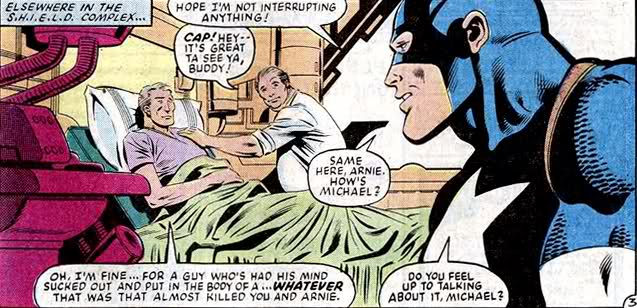
So I wanted to spend some time talking about one of the few canonically homosexual characters, one of the first homosexual characters openly acknowledged by Marvel starting in 1985, generated within the Captain America title.
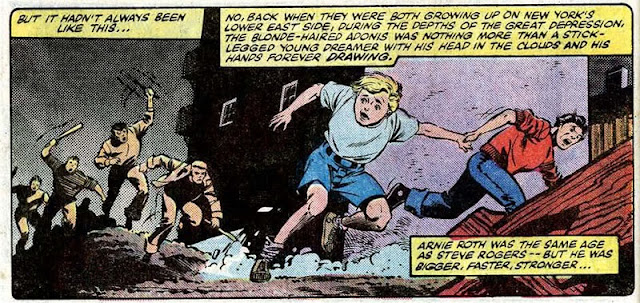
That would of course be Steve Rogers’ best friend since childhood, his one time sidekick who he seemed to be constantly saving, the man who calls him Stevie, saved him from bullies as a child, and who he jumps to the aid of no matter what hiatus has taken place in their friendship.

Obviously, it’s Arnie Roth.

When MCU revised the history of Bucky Barnes, in a lot of ways they injected Bucky into Arnie’s role, lending to why it’s so easy to assume more of Buck and Cap’s relationship within the film franchise.  Arnie is canonically gay but also merging the two characters makes for a much longer and more intense narrative between Buck and Cap as it fuses two vital relationships in Steve’s life.

Bucky and Steve have always had a long standing history of coming under scrutiny as a couple. When Ed Brubaker revised Bucky’s origin story, it cast Bucky into the protector role for Steve Rogers. It also aged Buck up significantly so as to avoid what the Comics Code had once deemed inappropriate bonding between a man and young boy. By fusing his loyal sidekick with his gay best friend, the MCU kinda set themselves up for #givecaptainamericaaboyfriend


Arnie is important. He is an often forgotten character worth noting because he was representation for LGBTQ+ characters, shown struggling with internalized homophobia, in a long term committed relationship. And his character was introduced in 1985
In the days where AIDS was still occasionally referred to as GRID (Gay-Related Immune Deficiency) (both terms coined in 1982). HIV was not a term used until 1986.
Not only that, but Arnie is anti-stereotype to the time. He is neither sexually promiscuous, a drug user, nor over sexualized.
He’s just some dude.


Arnie may be bumbling, old, but he’s an everyman. In many ways he’s starkly un-Bucky. Most importantly Arnie provides a concrete example of a homosexual character who is subtle. The fact that he is gay is never the point. And Steve doesn’t berate the point, either.

These storylines set a monumental precedent for LGBTQ+ characters in comic books. Arnie is treated very delicately given the time in which his character was developed.

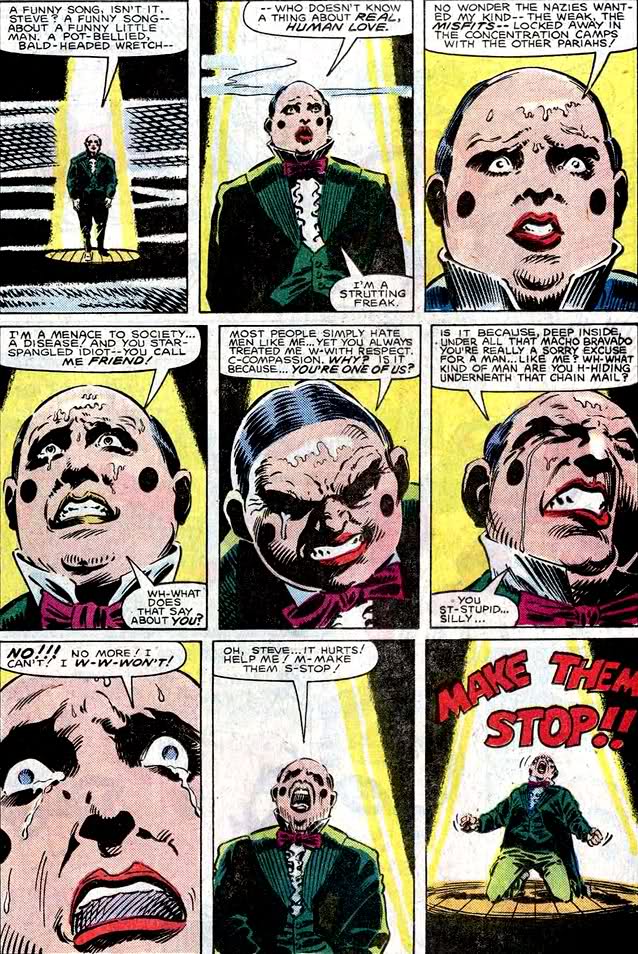
When his sexuality is forced to the forefront, it’s often a heartbreaking narrative on homophobia.

But most importantly, Cap reacts to homophobia, canonically, like this: 

Comics: Wonder Woman

Why hello there,

*sensible chuckle, smoking jacket, pipe*

I know a lot about comic books. I recently decided that for the month of July, since I enjoyed doing the Friday reviews themed, I was going to dip my toe into something I have tried very hard not to. Which is taking about comic books on the internet.

These aren’t going to be proper reviews so much as a couple essays about comic book material.

Which I am–as always–so looking forward to being told I’m wrong about.

All media are the result of their writers, their publishing companies, their political climate, their contractual obligations–none so obviously in recent years as those tied to film production companies.

I’m coming down from my mythology month by talking instead about what Denny O’Neil referred to as the American Mythology.

I can’t recall the source of the interview, it was ages ago that I saw it, but Denny O’Neil upon becoming the head editor of all Batman titles referred to himself as the custodian of an American mythology.

So, on the heels of talking about Antigone, it only makes sense I would talk about a different princess.


I’ve threatened to do this for ages when people chuckle nervously after asking me what I thought of WW84 and my eyes apparently turn white and start glowing.

In the past I’ve been deeply apologetic on behalf of the DCCU.

I will have to sing the sweet cries of Doom Patrol or Peacemaker some other night.

WW84 is a movie so deeply disappointing I had to write about it.


The good:

Pedro Pascal’s entire character arc. I would not cut a single scene. It was such an interesting and dynamic way to introduce magic into the unnecessarily gritty DC live action franchises and it’s true to WW writing. It had such potential for wonderment. From the instant his character wished to become the wishing well himself, I was immediately hooked into ‘oh shit, they’re doing DC-weird.’ I expected the character to be a Trump-esque joke and he was legitimately the most endearing, human character.

Kristen Wiig as Barbara/Cheetah was excellent, though I was a little bummed that she wasn’t utilized more in the final act. But the characterization, the scenes that she was in, all felt real. When they were playing villain music over her beating up the mugger, it was big ‘why are you booing, she’s right’ energy. I could have done with less establishment scenes of her being super strong. Like. I got it in one. She has super powers now. Time could have been shaved here. But Kristen Wiig was good and I didn’t mind seeing the cgi cats.

Barbara taking the moral high ground over Diana, repeatedly. Good. It was good. Barbara saying ‘I’m not going to let you hurt this man’ etc, and Diana being like ‘well, we could just kill him’ or Barbara saying ‘You want me to renounce my magic amulet wish, but you won’t do it?’ Good. GOOD.

Steve Trevor falls into multiple categories. Steve Trevor was….good? Chris pine was good. The concept that he was what she accidentally wished for from the stone, and getting to have fun acclimating him to the 80s as a newly rematerialized dude was fun. Way too long. I can only look at Chris Pine being slack jawwed so much. We get it, he’s from the past.

Gal Gadot is literally a better actress if Chris Pine is there. Her line deliveries are more smooth, their chemistry is great.


The meh: 

The Amazon’s representing truth/valuing truth over success. This is the more enduring theme of Wonder Woman. It’s why she has the lasso of truth. It’s Lex Luthor saying, ‘Superman seeks to pull out the best in us. Batman seeks to curb the worst. You…seek the truth.’

It was handled clumsily. A lot of the Diana a-plot felt badly edited while the villains b-plot was amazing, and that’s the ultimate summary of where everything in this movie went wrong.

Asteria’s armor. This is a grey zone between the good and the bad, because they clearly cut this entire story line for time and just….she just…..she just fucking had it in her closet. She just..she just fucking…’hey what’s that?’ ‘oh, it’s the armor of the most powerful amazon ever, don’t worry about it’. They didn’t even call it the golden eagle armor. Like

It’s an established thiiiing. I feel like there was an entire goddamn storyline here that just got cut for time because they didn’t want to spend too long on mythology elements, and that’s why this movie fails. Hard. They’re afraid to talk about mythology….in a Wonder Woman movie….If they had played up the importance of Asteria and the armor, the pay off would have been good. Instead, ‘oh, this old thing. M’not gonna wear it now when it’s plot relevant. Gonna wait till later for no discernible reason’. I want the Asteria plot.


The bad:

Why did…uhhhhh…why did we do that very long sequence in Thymiscyra to teach us about the importance of truth and not cheating and like…not mention ASTERIA and her sacrifice? Instead they were like ‘let’s have a long ass sequence, point at a statue of ASTERIA, and not tell you what she did.’ Why…uhhhh….why beat us over the head with a clumsily written theme and leave out the super important sacrifice altogether? When they talked about ASTERIA later it wasn’t like ‘oh yeah, that lady’ because we knew nothing about her, but we do know that Diana ran real fast at 10 years old.

Oh, and hey, while we’re here, WHERE DID SHE GET THE ARMOR? HAS SHE BEEN LOOKING FOR ARTIFACTS? IS THAT WHY SHE BEFRIENDS BARBARA, TO CONTINUE HUNTING? IS THAT WHY SHE’S WORKING AT THE MUSEUM? IT SURE WOULD HAVE BEEN NICE TO KNOW.

The random ‘hey look, we’re in the 80s. Haha, everyone is inconsiderate and bad, cause 80s!’, whoops, mini montage of WW saving people. Yeah. Cut it. Cut it? Cut it the fuck out. Everything about it felt heavy handed, top long, and stupid.

We also followed this mcguffin too closely? Like instead of following a consistent character in the beginning to establish a frame of reference, we talked almost exclusively about the rock.

The first ‘oh no’ I had was Barbara/Diana at dinner. That was so very clearly a date. I chocked up Gal Gadot being awkward to it being a date, though I was to later decide it was because that is how she acts. Maybe that’s how she thinks people talk? How did Kristen Wiig have good chemistry with Gal Gadot but not the reverse? Even when they introduce Steve to Barbara, Steve says he’s Diana’s ‘old friend’ and Barbara immediately, defensively, says ‘well I’m her new friend.’ Where the FUCK was my sapphic arc? Why did it die there? It’s never acknowledged again? And hey! Barbara’s smart! Steve said he’s a pilot and she goes ‘pilot’ and looks aside CAUSE SHE KNOWS HE’S A WISH. Because SHE IS A SMART AND GOOD CHARACTER. Barbara’s entire arc was wanting to be more like Diana and admiring Diana and wanting to be with Diana and it just….stops? Not even a ‘you rejected me?’

That poor man that the ghost of Steve Trevor possesses. Why couldn’t they just rematerialize Steve? Why did they disrupt this man’s life?

FUCK YOUR INVISIBLE JET. I’d like the invisible jet sequence more if you didn’t spent so much time showing us Chris Pine’s tonsils. This movie actually suffers from way too much Chris Pine. Is that a thing? Was that a thing before? Nothing …happened? It was him trying on outfits, then him going to museums, then him stealing a goddamn jet to go to CAIRO so they could be weirdly racist for a long fight sequence that had little payoff both in plot and action.

WHAT THE FUCK WAS THAT ENTIRE SCENE IN CAIRO? I looked away for one (1) second and they were all in tanks??? And then there were children playing soccer in the road IN THE MIDDLE OF THE DESERT? So we had to stop the weird tank thing and shoot a bullet from the TANK so she could ride it to catch the children from being run over by tanks?? And then? Like? None of this was good, well choreographed, or necessary. It was all literally so Diana could have somewhere to go in the invisible jet, be weird about middle easterners, and then get vaguely injured so they could say ‘oh noooo having your wish is diminishing your powers’. This whole thing could have been done LITERALLY ANY OTHER WAY. THIS WAS THE POINT AT WHICH I STARTED HATING THIS MOVIE.

Diana has to give up her wish-Steve to get her powers back, good. A good concept. Sacrifice. Would have tied nicely into that ASTERIA PLOTLINE that we didn’t get for some reason. She might have put on the super powerful armor THEN when her powers were diminished, but didn’t, for some reason. Wish-Steve saying ‘you don’t have to say goodbye, I’m already gone’ nice. Nice. Would have been a nice end to act 2. Sad. Except that it was undercut by web slinging the lasso into the sky and finding out that she knows how to fly now, a thing which receives a lot of visual but no verbal mention?

WONDER WOMAN CAN FLY, I DON’T DISPUTE THAT, I’VE READ A LOT OF COMICS, BUT WHY DID SHE NEED TO SOOOO MUCH? IT ADDED NOTHING EXCEPT AS A CALL BACK TO HOW SHE FEELS ABOUT STEVE. SHE COULD HAVE DONE IT ANY OTHER WAY AT ANY OTHER TIME. THE PAY OFF FELL COMPLETELY FLAT. And it lasted 27 YEARS.

Overall, this movie was so many interesting ideas cut together HORRENDOUSLY.


The best parts,

My compassion for Chris pine when he says ‘well shit, Diana’ as she fails to prepare him or the audience for what’s happening


So why is this dumpster fire something I feel the need to talk about?

The last book that I reviewed was Antigone Rising. In it, Helen Morales does discuss the Amazonian princess in question made a UN ambassador after the success of Wonder Woman (2017). But also, she discusses something which our culture and which Greek and Romans loved to do before us: Killing Amazons. The most popular subject for Ancient Greek pottery, after Heracles, is dead Amazons. Amazons were used as cautionary tales in many respects: here is what we do to women who disobey our gender norms.

Wonder Woman is a reimagined Amazonian princess which flies in the face of violence against women. She avenges the injustices that her sisters have faced for all of Amazonian literature. And what she represents is truth.

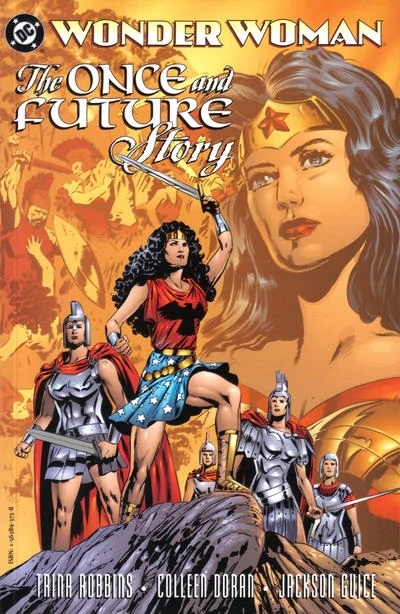
What I really want to talk about, what I wish we could see in a Wonder Woman film or franchise, is content like the August 1998 one-shot Wonder Woman: The Once and Future Story.

The plot revolves around two archeologists in Ireland uncovering Grecian tablets and asking Wonder Woman to translate the inscribed story. Her translation follows the forgotten history of the Ephesians and their princess, Artemis, as she leads a revolt against Theseus in retaliation for numerous acts of violence including the abduction, rape and enslavement of her mother. The heart of the story, while describing abuses against women in the ancient world, is that one of the archeologists is being abused by her husband.

Wonder Woman is forced to confront her own privilege; domestic violence is alien and repulsive to her, she has difficulty understanding–while other characters are so inoculated that they are able to dismiss it. Wonder Woman comes in to rescue, obviously, but is ultimately shaken at how systemic the problem is and doesn’t know how to proceed or why she was fortunate enough to be spared.

That is the correct way to write a Wonder Woman story. It does not need to be so heavy or dark as depicting women being slaughtered or staging an uprising, it doesn’t even need to address a strictly feminist issue. But it must be about using Wonder Woman to uncover a truth.

This is where Wonder Woman 2017 succeeded, why it succeeded. The young Diana is convinced that the Godkiller is a physical weapon, she has to discover that it is herself. Diana believes Ares’ deceptions and ultimately uncovers him as the primary villain.

Very importantly–one of the minor villians, Dr. Isabel Maru, is wearing a mask. I can wax poetic about this quite a lot. The female counterpoint among the villains is visually obscured because her appearance doesn’t please the men in power around her. It was flagged as abelist, it’s shitty, and that’s kind of the point. In interviews, discussing Dr. Poison, director Patty Jenkins referred to the injuries to the character’s face as self inflicted. Each element of what Dr. Poison represents, from her sadism to her callous indifference for herself, places her among the Nazi forces as ‘one of the good ones’–the only female in Nazi command. She is ultimately subservient, provided she isn’t interrupted from engaging in the experimentation she cares about. She does not care about the broader consequences of her actions, she celebrates them.

She is meant to be the counterweight to Diana. Diana is ‘one of the good ones’ not because she follows along with what the men tell her but because she is defiant in pursuing truth, not self interest.

I made mention above referencing a panel between in Dark Knights Death Metal (Nov 2020 issue) by Scott Snyder and artist Greg Capullo,

Writing anything less misses the point.

Review: Antigone Rising

Antigone Rising by Helen Morales

Making an effort to post a review every Friday!

This book was suggested to me by my sister based on a reading she’d had from it in a Classics course in her undergrad. I had been trying to think of a book that I had read that could finish out my mythology month that didn’t feel….overdone. There are plenty of amazing adaptations and re-envisionings of what we call classical literature—which frankly births from an extremely exclusive swath of location and time period and speaks to our fixation.

Classic should apply to more than one coastline.

This is one of the central arguments of Antigone Rising: The Subversive Power of Ancient Myths. We’re in a bit of a bind with the Greeks and Romans. We both look back to them for credibility in the duration of our cultural touchstones and we—idealistically, we realize that they were remarkably flawed.

Most of our modern interpretations of classical myths are heavily romanticized—which, frankly, the root word of romance is Roman. Our understanding is heavily through a pro-Roman, pro-Greek lens.

Brought to you by the battle of Thermopylae! May we present: centuries of narrowly defined social expectations.

I would guarantee that a given white cismale that I went to college with and sat in a theater watching 300 with could tell you wonderful things about the men of Sparta which glorify their warrior lifestyle. I know many people who gleefully took courses in Roman warfare. If I asked a single one of those men the role of the Gynaeconomi —I’d bet even money that they don’t know. And because it doesn’t effect them, they likely aren’t going to go too deep into investigating it.

That’s the pro-Roman bias.

Even in briefly looking up some supporting material before I wrote this review, there’s very little about the murky underbelly of Greek and Roman culture—yeah, believe me, whatever you think; it can get worse—that isn’t heavily blockaded behind paywalls.

But if you would care to dive deeper, I found Antigone Rising to be a highly accessible, well thought introduction to feminist topics laden within mythology. And given our propensity to look back to the Greeks and Romans as cultural touchstones inexorable from our society, it is certainly a stone worth overturning.

Consider, just briefly, the controversy surrounding Ovid’s Metamorphoses. I’m going to pick on this one because it’s personal. I like Ovid. That alone is controversial. I remember from my Latin days how Ovid was something the boys snickered about because of the depictions of rape and bestiality and all manner of frenzy which the sixteenth century-to-present ‘westerners’ went on to cherry pick for their personal use. But as the argument is made in Antigone Rising, Metamorphoses was a deeply political book. Removing it from the political atmosphere of Augustus we fail to see how these allusions to Apollo raping virgins were criticisms of the empire—not religious text. Ovid purposefully chose gods and mythical figures which the empire had aligned themselves with in symbolism to debase and villainize as a critique of the end of republicanism.

This is a huge issue in interpretation of ancient text, particularly when you dip your toe into looking at who has been allowed to do the interpreting for the past few centuries. If we look at Ovid with absolutely no context, we can interpret a glorification of rape, of sexism, of many things which don’t align with political or historical evidence.

Back quickly to the gynaeconomi—that term refers specifically to the magistrates assigned to police women’s behavior, dress, and public lives in Athens. Morales discusses the gunaikonomoi still being a topic of Oppian Law which was disputed as unnecessary by Cicero—and I use this as example of how we today cherry pick our roman heroes.

My latin teacher was obsessed with Cicero. Keekarooo. Her beloved.

“And let us not set a prefect over women, in the fashion of the elected office among the Greeks,” her false feminist agenda might have read. But Cicero’s quote ends, “but let there be a censor, to teach husbands to control their wives.”

The same cherry picking is brought up and lingered on in an essay about weight loss and Hippocrates. Particularly in diet culture, Hippocrates quotes surface which are often contradictory, sometimes to the point of being meaningless, and neglect to say that Hippocrates’ wisdoms about not being fat are sandwiched in between advice about rubbing goat shit on your head.

It’s a good introductory book. I’d read more of it.

Review: Ariadne

Making an effort to post a review every Friday!

Ariadne by Jennifer Saint is an excellent introduction to mythological retellings and fiction which focuses on Ariadne, obviously, but also on her sister Phaedra. The story switches perspective between the two sisters telling both of their stories and how they diverge, beginning the with their close relationship in childhood, to the eventual tragedies both are known for. It emphasizes how different interpretations of the same familial trauma shape their personalities and choices. Neither sister is hero nor antagonist, but rather a result of the roles placed upon them within a patriarchical society—beginning with an abusive and controlling father.

To the uninitiated, Ariadne and Phaedra are both sisters to the Minotaur, daughters of King Minos and Queen Pasiphaë. Ariadne is of course most famous for assisting Theseus in his quest to slay the Minotaur and being immediately abandoned by Theseus on Naxos. And appropriately, this book portrays Theseus as the benign villain that he is. Let me explain that word choice. Theseus isn’t maliciously evil. He doesn’t abandon Ariadne out of spite or ill will; he does it purely because she isn’t useful to him any longer. It’s indifference and self importance that drive Theseus, and it is the small amount of value given to these women which justifies it.

This is largely a story of how women suffer through the inconsiderate nature of the men around them; how if men were not in charge of those women’s lives, they could be self determined. Both Ariadne and Phaedra are intelligent, clever, problem solving. But it is the hubris, pride, the need for self advancement—again and again it is the women who suffer in mythology from the hero’s pursuit of glory.

Phaedra, in contrast to Ariadne, tries to be self determined. She tries to push forward, to behave as a man would, she tries to pursue what she wants—but when she pursues an affair and isn’t wanted in return, society doesn’t behave the same way toward a woman as it does a man. She can’t be successful, she can’t force herself or her will onto others, she is shamed. She has no way out.

I liked very much the portrayal of Dionysus and his relationship with Ariadne, the portrayal of their marriage, though ultimately the story ends in the same theme that it begins—that the hubris of a man is responsible for the downfall of women in his life.

It’s not a kind book to the men in it, and it shouldn’t be. It isn’t meant to be. Because very little is actually changed. The course of events is the same as it is in the mythology. It’s merely a step taken slightly to the left, to the women in it. They have the microphone, though they’re still only wanted as stage dressing.

Review: Heroes, Mythos

Making an effort to post a review every Friday!

This one is going to be a little different. I seem to have decided that June is going to be mythology-fiction month as it is my birthday month and as I enjoy mythology. Tomorrow, in fact, is my birthday, so I’ve made more work for myself. I’m going to review two books. One I will give a good review—a spectacular review! I really liked it! And one I will give a bad review. Both books are by Stephen Fry.

Heroes, by Stephen Fry, and Mythos, by Stephen Fry.

I was given Heroes as a gift and I read it out loud to my children. Generally speaking I don’t enjoy reading out loud to children. They stop you. They ask a lot of questions. There’s a good deal of ‘wait, can we actually read something else’, ‘I need a drink’, ‘what were you saying, I saw a particularly interesting bug,’ and ‘HELP! A BUG!’

If it’s difficult to wade my way through Pete the Cat, which is ten pages long and rather easy reading; you can imagine that reading a chapter book would be tortuous. Heroes, however, I read cover

to cover– to my kids.

I love the framing, the presentation. There were stories which I was less familiar with, stories which I hadn’t known –which I then obnoxiously related those new factoids to people around me, eager to show off some detail or otherwise retell a story like a small child showing off their bedroom to house guests.

I enjoyed this book, I enjoyed the stories immensely. I like an anthology from time to time, and I liked how legends were connected and presented. A text book, nearly, without the stuffiness of academia. It was intelligent, easily read, easily understood, presented exquisitely.

Mythos was a different story. I bought Mythos on the heels of reading Heroes, with the blind confidence of ‘ah, this is more of that stuff that I like’.

I generally make a point of not reviewing things I don’t like, but I want to do a bit of a post mortem—because at this exact moment, I can’t tell you why I didn’t like it.

That’s not very flattering to me as a person who analyzes and writes about things daily.

I like Stephen Fry. I generally trust Stephen Fry. I don’t know that I would hand him a baby because I don’t know that he would be comfortable with that, but I haven’t ruled it out. If Stephen Fry is presenting a documentary or waxing poetic and I say, ah, yes, Stephen Fry. My good friend, Stephen Fry.

I like mythology. I liked other books by Stephen Fry about mythology. I was willing to read them out loud to small children, which is the equivalent of nailing jello to a herd of cats.

I just could not bring myself to like this book.

I am so sorry, my good personal friend Stephen Fry. I am truly baffled.

I learned a few things from it. I repeated factoids, as I am wont to do. I took in and absorbed information. I made a casual reference to Ouranos in regular conversation, which is not easy for most people. What am I doing wrong? Why don’t I like this book? Why have I failed you, Stephen?

Is it something I ate?

Do I need to adopt a new technique, ritual? I will admit, and I think this is worth talking about—I try to read a book a week. I have a goal of reading a book a week. But most often, I read three books in a week and other weeks I lie on the floor and have staring at the ceiling time.

It’s entirely possible I was just burnt out.

I want to revisit it. I want to challenge myself to revisit it—because Stephen Fry is an amazing story teller. But perhaps right now it is just time to stare at the ceiling.