Tag: fantasy

Review: Thistlefoot


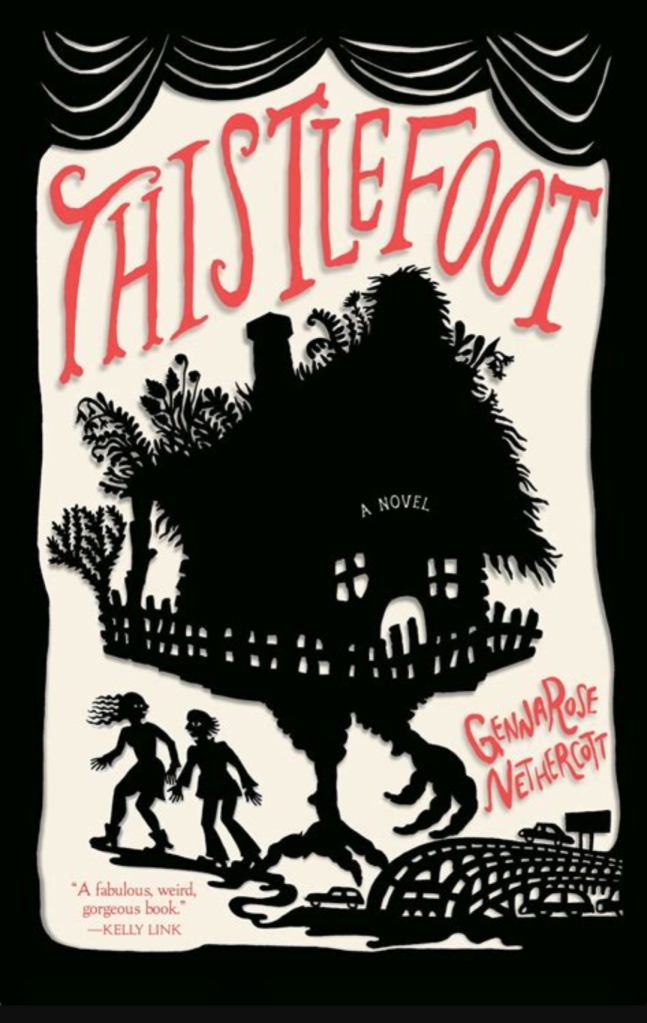
Thistlefoot
GennaRose Nethercott

I’ll cut to the chase, this was one of my favorite books I read in 2023.
Thistlefoot takes place in a world of magic and not, a world where most things are exactly the same as they are in reality but with an important exception —the scars of an event can awaken the spirit of a place.

One of the early mentioned examples of this is a Burger King that grew eyes after a break in.

Thistlefoot, the book’s name sake, is a house that sprouted chicken legs.

The sibling pair at the heart of the story, Bellatine and Issac Yaga, are the inheritors of Thistlefoot and the generational trauma that both makes them who they are and that has been kept from them by their family. They both have their own unusual gifts, which unbeknownst to them are adaptations to that trauma. The book examines disapora in a fascinating way.

The story follows both the Yaga siblings and the history of the house itself in a slow burn reveal of the tragic events that led Thistlefoot to sprout legs and flee.

All while being hunted by a similar oddity, which intends to destroy Thistlefoot.

This book was such a delicate and well constructed handling of generational trauma and particularly genocide. I had gone into it blind and was taken in immediately with the world and characterization.

It’s an absolute recommendation.
Review: Big Bad

Big Bad
Chandler Baker


A copy paste disclaimer! :There are several stories available for free download if you are already subscribed to amazon prime, and I took advantage of that recently and thought I’d spend November telling you about the short stories and novellas I picked up that I liked best and thought was worth the read.

These tend to be stories commissioned by Amazon and put into collections by Amazon

Okay, back to review:

From the first line I knew I would like this one; a horror story wrapped in a failed marriage and the other way around.

At 58 pages, it’s a very quick read. The pacing and characterization is a lovely build to the end of the story; the twists are both obvious and not, telescoped well but always leaving the reader with doubts.

It’s another of those stories that is difficult to talk about without spoiling the whole of it, so very worth the read.

I honestly started to say more but am not sure how to without giving it away haha

The characters are extremely well done and feel organic, even under their bizarre circumstances.

Review: What the Dead Know

What the Dead Know
Nghi Vo

A copy paste disclaimer! :There are several stories available for free download if you are already subscribed to amazon prime, and I took advantage of that recently and thought I’d spend November telling you about the short stories and novellas I picked up that I liked best and thought was worth the read.

These tend to be stories commissioned by Amazon and put into collections by Amazon

Okay, back to review:

Of the stories I read, this one has stuck with me a long time. The narrative is immediately engaging, the characters relatable and enjoyable. It’s one of those stories difficult to talk about without spoiling it because you want to pull others into this same world that you were pulled into.
The gimmick of two con artists, one being utilized for and also taking advantage of the ignorance of those around them because of their race; the communication with spirits and motif of revenge all check very important boxes to me.
Of the ghosts stories I’ve read, which is not a small number, several of the images in this story are so evocative that they’re well stuck in my craw. I absolutely would recommend this story to anyone and at 30 pages it leaves you both wanting more and satisfied.

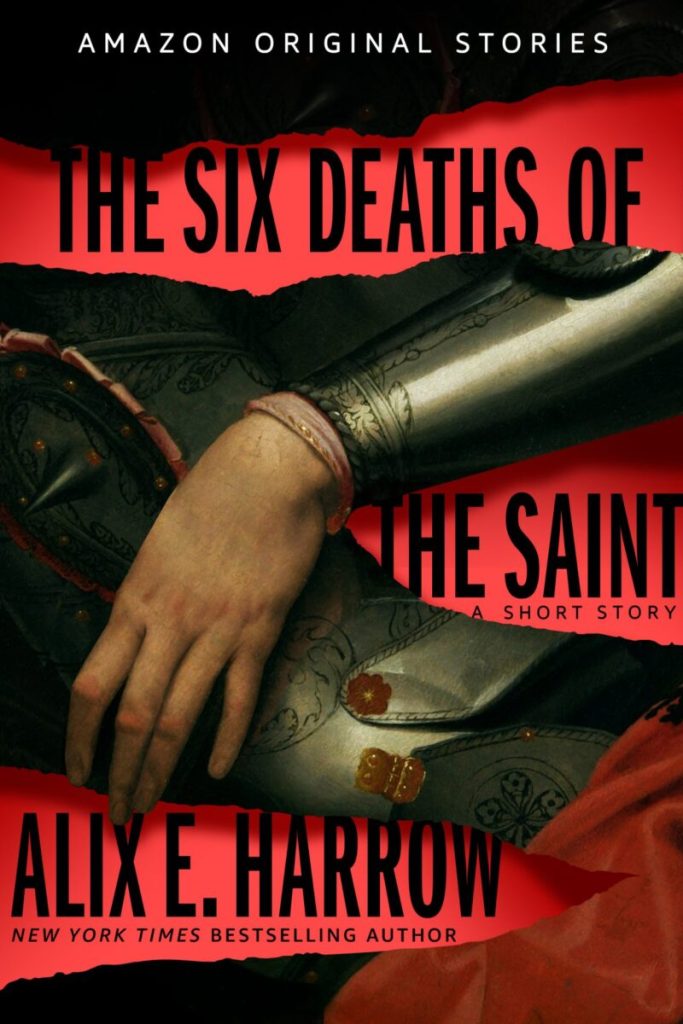
Review: The Six Deaths of the Saint

The Six Deaths of the Saint
Alix E Harrow

A copy paste ! :There are several stories available for free download if you are already subscribed to amazon prime, and I took advantage of that recently and thought I’d spend November telling you about the short stories and novellas I picked up that I liked best and thought was worth the read.

These tend to be stories commissioned by Amazon and put into collections by Amazon

Okay, back to review:

*Vomit, scream, fall over in vomit*
It’s perfect.
Professional start, no?

I absolutely adored this story. It checked every mark for me: time travel, time loop, deal with the devil, character development by progressing through trauma, sacrifice motif, clear evil, unclear anachronistic time period. The tone and voice of the story was so clear and strong immediately, the narrative wasting no time to establish the character outside of anything other than a force to be reckoned with through the motif of willpower.
I have recommended this short story to so many people at this point that even at 29 pages I’m willing to offer it up as one of my contenders for my favorite book I’ve read this year.
It is beautiful, the wording and flow of sentences purposeful and well sculpted.
No notes.

Review: Honeycomb by Joanne M Harris

I’ve been sitting on writing this review because I’m not sure how I want to structure it. Structure is fundamental to Honeycomb by Joanne Harris and this is my second contender for my favorite book that I’ve read in 2023.

In fact, the reliance on bees within the story is, I’m sure, a direct reference to the importance of structure to the novel.

I want to be assured that I do it justice.

Honeycomb is presented as a series of short chapters introducing interlocking stories and continuations of earlier chapters and characters, chiefly following The Lacewing King. Characters are, importantly, not named but given honorifics as the book utilizes traditional fae myths. As a person with ….an unkindly level of entomophobia, you’d think that this book would be near impossible for me to read as the many factions and clans of fae are all based on different insect species. However, I persevered and I actually really enjoyed the way the insects and the affectations of each fae were discussed.

Anyone who may remember the horrific katydid incident last year where I blew up discord channels and texts demanding to know how I got rid of the beast that had flown into my window (it took me four hours to work up the nerve to trap him between the screen and sliding glass door) should be very proud of me!

Not only did I push through, but this book has stuck with me incredibly. I love the very arch yet traditional approach to fae stories. It was nostalgic, reminiscent of reading collected fairy tales and brother’s Grimm compilations, but with an interconnecting thread that built and drove you deeper into the world that Ms. Harris was creating. It had an atmosphere similar to Susanna Clarke’s fae. The characterization both holds you at a distance as a reader and is engrossing, drawing you in to learn more about the various flawed characters and is reminiscent of old school fantasy like George MacDonald.

I recommend it highly.


Review: The Ladies of Grace Adieu

This book was a bit of a struggle for me, admittedly, because while I adore Susanna Clarke and the tone, atmosphere, and world that she’s created, it was frankly strange to get accustomed to her in a short story format after Jonathan Strange and Mr. Norrell.

I found myself half way through the book before I struck on my favorite story of the lot, “Mr Simonelli or the Fairy Widower”. 

Prior to that it felt like I was floundering a bit looking for the punchline at the end of each story. “Ah, Rumpelstiltskin”, for example.

But the stories about fae folk are where I think Susanna Clarke really makes her name and sets the flag. She’s rekindled for me, a person who loves deals with the devil, just how devilish and dealing fae can be.

The stories after this midway mark all bear the same tone and quickness I expected of Susanna Clarke from Jonathan Strange and Mr. Norrell, down to the copious footnotes in “Tom Brightwind”. I worry I wouldn’t have stuck with the book if not for “The Ladies of Grace Adieu” themselves, the first story of the collection, which had all the snark and turn I like of her style.

Now I’m a bit struck at a loss because I’ve run out of Susanna Clarke to read. There’s a surrealist aspect to some of these stories that had me thinking of what it would be like if Samuel Beckett was writing fantasy. I already miss it. The atmosphere is hard to capture as effectively as Clarke consistently does.

I almost immediately passed off my thrifted copy to a friend; I need these stories still circulating.

Review: Juniper and Thorn

Juniper and Thorn is a fast paced and engrossing book billed as a retelling of The Juniper Tree. I wasn’t actually familiar with The Juniper Tree and sought out the fairy tale; I find that a lot of fantasy recently has been reviving the Brothers Grimm. Once I read it I did vaguely recall: 

A kindly man and woman, unable to have a child, do so through apple-magic, as one does. The wife promptly has a baby and dies, as one does. The wicked stepmother comes in and has her own child who she wants to inherit the father’s estate and so she lures her stepson to look into a crate then slams the lid down decapitating him, as one does. 

In a fit of just unusual cruelness, she then reassembles him, props him up, and encourages her daughter to go ask him for an apple. The daughter does, he’s suspiciously not listening, step mom gives a good ol’ “Whack him!”, the daughter does, and his head falls off.

You know.

The daughter, deeply distraught about her brother’s death, gathers up the dismembered parts and puts him back together while attempting to give him a proper burial beneath a juniper tree. Oh, I forgot to mention the stepmother also tricked her husband into eating some of the corpse. You know.

The boy gets transformed into a bird, he drops a millstone on the stepmother, he turns back into a boy, everyone has lunch. You mother’s dead, you’re brother is a revenant, time for Red Lobster.

Reid cleans this up a bit into a love story involving deceiving fathers and the necessity of being a bit monstrous to overcome them. Within the greater novel this myth serves as a backbone both in ways reflecting themes of the narrative and serving as the inspiration for the ballet in which Sevas, the male lead, performs.

Outside of that inspiration, the story is a well constructed fairy tale inspired by Russian, Jewish, German cultures that has that childhood-fantasy nostalgic allure while keeping things R rated. I really enjoyed it, much like I did The Wolf and the Woodsman (read the review here: https://aliactast.com/2022/03/18/review-the-wolf-and-the-woodsman/) , also by Reid and taking place in the same fantasy world building.

I found Juniper and Thorn to be a tighter narrative than Woodsman that focused singularly on the characters and their progression through the story, letting you be thrust into the world rather than taking the time to linger on world building. That said it’s very much a stand alone story which holds its own weight, I appreciated being thrown in rather than having my hand held. 

I’m continuing to really like Reid’s writing style and now I’ll have to hunt for what’s next.

Review: Jonathan Strange and Mr. Norrell

Making an effort to post a review every Friday!

I’ve referenced Susanna Clark’s Jonathan Strange and Mr. Norrell in the last two reviews I wrote and upon realizing that I thought maybe I should say something about this book I’ve unwittingly referenced back to multiple times. I had pegged Piranesi earlier this year as a contender for my favorite book of the year (since I’ve read it recently, of course; I certainly don’t do anything chronologically). Susanna Clark writes like a historian. Anyone who has read the introduction at the beginning of The Ladies of Grace Adieu, the collection of stories, could tell you that the references and style in her short story work is reminiscent of a researcher who has happened upon these stories and is sharing them with you purely from the perspective of historical interest. You clearly already know this history, having lived it yourself, but here is a scholarly assessment to embellish upon your public school education.

It is educational without being pretentious and it never breaks character. You are always within her world once you have consented to read it. Piranesi, I felt, accomplished this in a much shorter format—which I would argue is more difficult.

I read an absolutely dogshit review of Piranesi where the reviewer complained that Susanna Clark had phoned it in after producing the masterpiece that is Jonathan Strange and Mr. Norrell, that the story became too character and too plot driven, and that there wasn’t nearly the same psychotic attention to minuscule detail that didn’t advance anything—you can see where I’ve put things into my own words. I cannot understand a criticism less than one that is upset that book has a tightly knit plot. That’s what we all want, for a plot to fold in on itself like a musical score; criticizing Piranesi for doing what Jonathan Strange and Mr. Norrell does in less words is…you don’t understand fiction. You’re welcome not to like a book, but by god, what a reason.

Jonathan Strange and Mr. Norrell is, of course, a difficult act to follow. Nearly a thousand pages, it stands around 782 depending on the print, and it is a complete history written in the sensibility of its characters—academic and practical scholars of English magic during the Napoleonic wars. I would argue that it is meant to be written in a way that not even Mr. Norrell could criticize it. It is a thoroughly and joyously British Book. It celebrates English character, ideals, and it’s nearly like reading Edith Hamilton’s Mythology in its textual reverence for its own story.

It is a very good feeling to read something and to feel that it couldn’t have been done any other way. That what the author intended—which as a reader you’re only guessing at—feels accomplished. The show’s effectively over. I read Jonathan Strange and Mr. Norrell as though it was truly a historical text, I paused to look up references, I enjoyed the archaic spellings of words that are period-accurate woven throughout; I really studied this book in several ways and it feels complete to me. I didn’t read it, rushing through, with the speed or mentality of a memoir or fantasy book as I usually would; instead I treated it like an academic study and I just—I have no notes. There’s nothing I could argue could be done differently or would have had a different character or appeal if done differently. The book is what it is and it is whole. Changing any aspect would both cheapen it and make it a completely different book.

That comment I made before on wanting a plot to fold in on itself like a musical score; it’s okay if you read a book and you can see the trajectory of the plot and where it is headed. I read another dogshit review recently of a different novel complaining that the reviewer skipped ahead a few chapters and figure out the ending. Well, of course you did. You read ahead of yourself. Books should have refrains and reprisals. The whole spine of a novel should be its effective foreshadowing without being terribly obvious—but yes, you’re supposed to be guessing at the ending. It’s called being engaged.

I think there is this bizarre push these days, and I’m going to blame things like cheap fx popcorn sellers, to have a twist ending. You want to be surprised by a book. But a lot of the joy, especially in a story that involves prophecy, is that you as the audience know what is happening and are watching it unfold. It is not an author’s job to psych you out. It is an author’s job to raise you to their level, it’s a communication not a deception—and what a more elbow nudging way to do that than to pretend that your fantasy is a reality that has already taken place and that everyone surely knows the punchline to.

The book is too short.

Review: The Once and Future Witches

Making an effort to post a review every Friday!

The Once and Future Witches by Alix E Harrow

I had to look it up afterwards, this book came out in 2021 and was up for several awards, winning the British Fantasy Award. I feel it had an enormous amount going on in it. It was a complicated book that either could have been split into several shorter stories, or a book that could have been fleshed out into a thousand or so page tome. I get the impression that the author would be happy to do either as it seems these characters are very loved.

It is not to say I didn’t enjoy this book but I sometimes wondered what this book wanted to be. It’s dense, it’s a heavy book to contend with but at no point is there not a lot of forward motion. It propels the reader on, character driven, though there were things I admittedly would have liked to stop and examine or characters I would have liked to have spent more time with rather than switching as much as we did between the sisters. I think it’s a mark of how well written and crafted the book is that is really shouldn’t be read quickly. It’s something that ought to be sat with.

The plot follows three sisters in a maiden-mother-crone dynamic who have fallen out due to various revealed traumas but are drawn back together by a series of magical events tantamount to magical terrorism –events are blamed on witches in an effort to undermine the suffragist and women’s rights movements during which the story takes place. The setting is a fusion of rewritten history with magical context, very in the vein of Jonathan Strange and Mr. Norrell but without Susanna Clark’s historian sensibility; instead lessons are infused throughout the story rather than explained or footnoted in. It’s presented as though you’re already meant to know it, which I do like this style of being thrown into the kiddie pool. I absolutely loved the prose, I loved the way which the author sticks fingers into nooks and crannies to pull out grubs of information, but I found myself at times distracted by the switching between characters. This, honestly, shows an effective writer. I wanted to stay with a character I was reading about, not move to whatever sister provided the next plot point right away, but it also made it feel like it was written with a television-season sensibility. You could see the commercial breaks. I am no less guilty of that in my own writing, but it is something that’s had me stop and consider if I want to continue doing that in my own manuscripts.